Utility installation across Knox County presents distinct mechanical demands due to the regional transition from red clay topsoil into fractured limestone and river gravel. A walk-behind trencher cutting 4 to 6 inches…
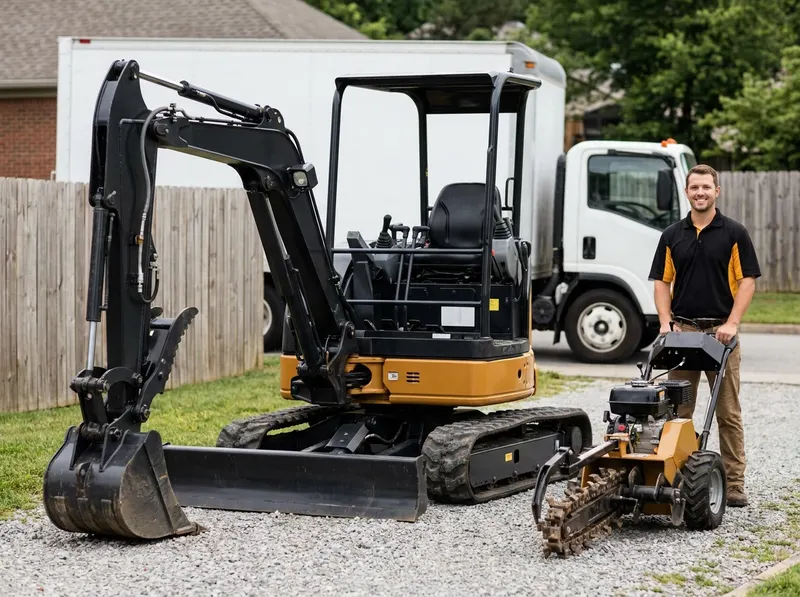
Utility installation across Knox County presents distinct mechanical demands due to the regional transition from red clay topsoil into fractured limestone and river gravel. A walk-behind trencher cutting 4 to 6 inches wide handles residential 240-volt conduit lines, low-voltage landscape lighting, and secondary water mains in established neighborhoods like Bearden, Fourth and Gill, and Old North Knoxville. For running lines near mature river oaks in Island Home Park or Sequoyah Hills, a compact mini excavator equipped with an 18-inch trenching bucket provides the necessary hydraulic power to slice through fibrous root mats where a standard wheel trencher may bind. Tennessee 811 marking is mandatory at least three business days before ground penetration to prevent strikes on buried natural gas, municipal water, or high-voltage electric lines.
Selecting between machine footprints hinges on surface clearance and target depth. A dedicated track trencher maintains a tight 36-inch operational width that squeezes through standard backyard gates in Rocky Hill and Fountain City without taking down fence sections. The trade-off is linear speed versus maneuverability: dedicated trenchers cut straight lines rapidly on open ground, but cannot dig curved transitions, footings, or bell holes. When projects involve multi-directional drainage lines, culverts, or crossing rocky subgrades in West Hills, a 3.5-ton mini excavator provides boom swing articulation and higher breakout force, though it requires broader track clearance and careful staging to avoid rutting damp turf. Driveway protection boards and track mats are standard drop-off recommendations to prevent cosmetic damage to asphalt or decorative concrete aprons during offloading.
Logistics are organized into three clear phases: 1. Confirm your trench depth, path length, and width to set the correct tooth configuration (cup teeth for clay versus rock teeth for shale). 2. Receive equipment drop-off directly to your job site in South Knoxville or surrounding Knox County zones with ground-level operational orientation. 3. Complete backfill and call (865) 489-3488 for prompt retrieval once utility lines are inspected and covered.
Every job gets a firm, written price after a free on-site visit.
Tell us about your trenching and utility installation equipment job in Knoxville and we'll send a clear, written quote, usually the same day.
 BinRocket Dumpster Rental