Excess water stops ground operations immediately, whether runoff pools along low-lying properties near Island Home Park along the Tennessee River or fills foundation trenches on hillside builds in Rocky Hill and…
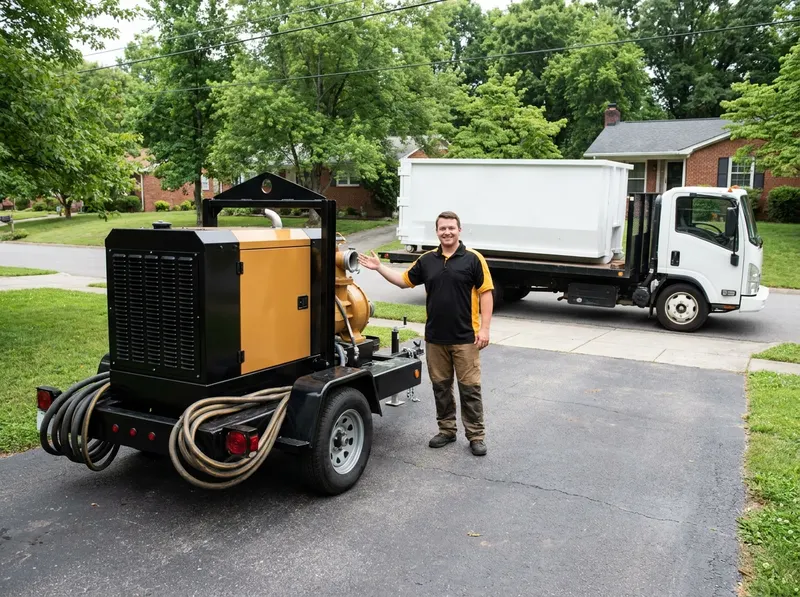
Excess water stops ground operations immediately, whether runoff pools along low-lying properties near Island Home Park along the Tennessee River or fills foundation trenches on hillside builds in Rocky Hill and Sequoyah Hills. Choosing the correct water removal setup depends strictly on solid particle size and power availability. A standard electric submersible dewatering pump works efficiently for continuous, quiet draining of clean or slightly gray basement water where an electrical outlet remains operational. In contrast, a gas-powered centrifugal trash pump handles heavy slurry, mud, leaves, and solids up to 2 inches in diameter on remote excavation sites. The trade-off is mechanical clearance versus portability: standard dewatering pumps offer light handling for interior sumps, while heavier trash pumps require dedicated outdoor ventilation and clear grade positioning to maintain a steady suction prime.
Knoxville's heavy clay subsoils frequently prevent natural drainage after sustained Appalachian rainfall, forcing pooling around footings in Bearden, Fountain City, and historic crawl spaces throughout Fourth and Gill and Old North Knoxville. Setting up equipment requires exact elevation planning. Centrifugal pumps operate on atmospheric pressure and experience suction lift limits of roughly 25 vertical feet from the water surface to the pump intake; exceeding this elevation drop starves the impeller and burns the mechanical seal. For deep basement excavations or drainage retention ponds near West Hills and South Knoxville, positioning the pump unit as close to the water source as possible maximizes output gallons per minute while reducing strain on reinforced intake hoses.
Pumping logistics follow a clear three-step operational workflow. Step 1: Measure total vertical lift from water level to the discharge point and choose a 2-inch pump for under 200 gallons per minute or a 3-inch to 4-inch pump for site clearing up to 500 gallons per minute. Step 2: Lay suction line flat without high loops to eliminate air pockets, submerging the intake strainer at least 12 inches below the water surface to avoid pulling surface air. Step 3: Run discharge hoses downhill away from adjacent property lines toward approved municipal storm sewers or sediment traps, ensuring compliance with Knox County stormwater runoff ordinances without washing out down-gradient driveways.
Every job gets a firm, written price after a free on-site visit.
Tell us about your dewatering and trash pump rental job in Knoxville and we'll send a clear, written quote, usually the same day.
 BinRocket Dumpster Rental